Kraft Bin Boxes Cut to Your Shelves
Bin boxes are open-fronted corrugated trays that sit on a shelf so you can see and grab what is inside. We cut them to your shelf depth and stock, with dividers if one bin holds several items.
Written price from£0.25 a box
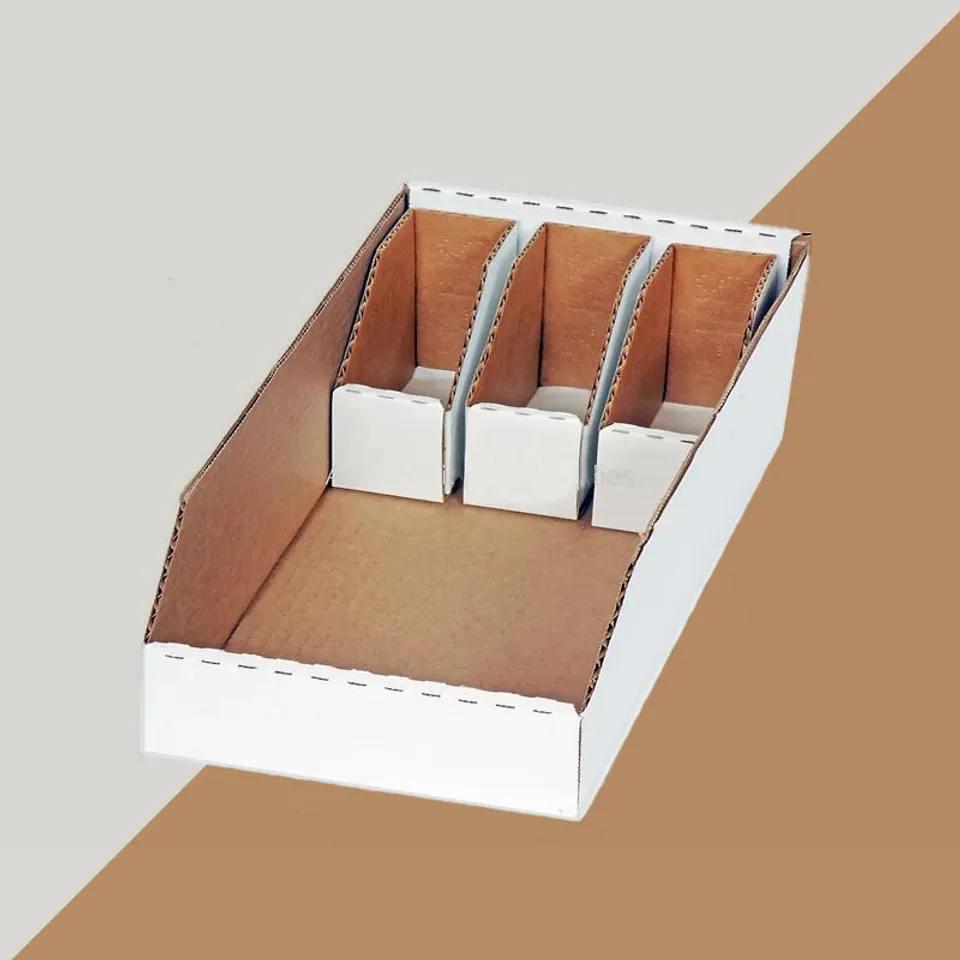
What are kraft bin boxes?
Kraft bin boxes are brown corrugated storage boxes with a low or sloping front, made to sit side by side on shelving. They keep small stock, parts and supplies sorted and easy to reach. They arrive flat and fold up without glue or tape.
- Front
- Low or sloping open front for reaching in
- Dividers
- Optional fixed walls splitting one bin into sections
- Label area
- Front lip for a printed or handwritten label
- Arrives
- Flat, folds with locking tabs
Kraft Bin Boxes Sizes
| Size | Typical inside size | Fits |
|---|---|---|
| Narrow | 100 × 300 × 110 mm | Small parts |
| Standard | 150 × 300 × 110 mm | Stock items |
| Wide | 200 × 300 × 110 mm | Bulky items |
| Divided | 300 × 300 × 110 mm | Mixed small stock |
Sizes are typical starting points, not stock sizes. Every box is cut to the inside size you send.
Where are bin boxes used?
Stockrooms are the obvious place. A row of bins on a shelf turns a mess of small packets into something you can count at a glance.
Shops use them under the counter for spare stock and on display shelves for loose items such as soap ends, seed packets or socks. Workshops use them for fixings and parts. Online sellers use them at the packing bench, one bin per product.
Schools, salons and small offices order them too, for stationery, towels or files that need a home on an open shelf.
They belong to our kraft inserts and dividers collection, which covers the boxes that organise rather than post.
How is a bin box built?
A bin is a long open tray with a back, two sides, a base and a front that is lower than the back. Some have a sloping front, cut away at an angle so you can see in from above and from the side.
Our photos show three versions: a bin with tall internal walls dividing it into narrow slots, two slim bins with several sections each, and stacked brown bins with angled open fronts. All fold from a single sheet and lock with tabs, so there is no glue or tape to deal with.
The back wall is usually the tallest panel, which stops stock sliding off the rear of the shelf.
- Double-layer front lip that keeps its shape when pulled
- Sloping sides so you can see what is inside from the aisle
- Locking tabs that hold the bin square
- A flat front face that takes a label
What size bin box do you need?
Start with the shelf. Measure its depth from front edge to back wall, and the clear height between shelves. The bin length usually matches the shelf depth so nothing gets lost at the back.
Then decide how wide each bin should be. Narrow bins suit small parts; wider bins suit bulky items. The sizes below are starting points only, given as width × depth × height.
| Bin | Inside size (mm) | Usually holds |
|---|---|---|
| Narrow | About 100 × 300 × 110 | Small parts, labels, tubes |
| Standard | About 150 × 300 × 110 | Everyday stock items |
| Wide | About 200 × 300 × 110 | Bulky or boxed items |
| Divided | About 300 × 300 × 110 | Mixed small stock in sections |
Should a bin box have dividers?
Dividers are worth it when one bin holds several similar items. A single wide bin split into four sections takes the place of four narrow bins and keeps the shelf tidy.
If every item needs its own label, separate bins are often simpler. You can move them around as stock changes without reorganising a whole divided bin.
Divider walls can run the full height of the bin or stop short of the front, so you can still see into each section from the aisle. Say which you prefer when you send your sizes.
Which board is right for a bin box?
Brown kraft corrugated is the standard. It stands up on its own on a shelf, the edges show the familiar fluted line, and the brown colour hides dust and finger marks well.
A white outer face, like the white bins in two of our photos, makes labels and printed numbers easier to read. White-lined board is available on request.
Corrugated also takes a crease well along the front lip. A double-folded lip keeps its shape when you hook a finger over it to pull the bin forward, which happens dozens of times a day in a busy stockroom.
Can bin boxes be printed or labelled?
Most bins stay plain and get a sticker or a handwritten label on the front lip. That keeps them flexible when stock changes.
If you use bins on a shop floor, a one-colour logo on the side or a printed number on the front looks tidy. Black ink on brown is clear from a few steps away. Our guide on brown, white-lined and corrugated kraft board explains how each surface takes print.
How do you set up a shelf of bins?
- Measure each shelf and list what goes on it.
- Group items by size and pick a bin width for each group.
- Order a few spare bins of each width for new stock.
- Fold the bins and line them up with the low fronts facing out.
- Label the front lips before you fill them, while they are easy to write on.
What mistakes do people make with bin boxes?
Most of them come from sizing the bin before looking at the shelf.
- Bins deeper than the shelf, so they stick out into the aisle
- Bins too tall for the gap, so the sloping front cannot be seen into
- One width for everything, so small parts disappear in large bins
- Overfilling, so the front lip bows outward
- Forgetting space for a label on a sloping front
Can bin boxes be stacked?
Some bins are designed to stack, as one of our photos shows, with the open front of the top bin set back so you can still reach into the lower one. Tell us if you want them to stack and we shape the sides to suit.
Stacked bins work best for light stock such as packets, labels or soft goods. For anything dense, keep one bin per shelf level.
Stacking also needs a little headroom between shelves. Measure the gap before you decide on two levels of bins.
Bins at the packing bench
If you pack orders yourself, a row of bins along the back of the bench keeps tape, labels, stickers and inserts within reach. Pick a bin width for each and they line up like a small shelf unit.
Spare flat bins take almost no storage, so you can add more as the business grows.
A bin per product line also makes stock checks quicker. You can see at a glance which item is running low and reorder before the bin is empty.
How do I order kraft bin boxes?
Send your shelf depth and height, the bin widths you need, whether you want dividers and the quantity of each. Mention any print or labels.
Small plain bins start from £0.25 per unit, and the written quote gives your exact price. A free proof shows the dieline and any print, and our designers keep editing until it is right.
Production is 4–6 business days from approval. Free tracked delivery covers the UK and takes 2–3 business days. If bins arrive wrong, damaged or misprinted, photos inside 10 days get a reprint or refund.
Related Kraft Boxes
All inserts and dividers boxes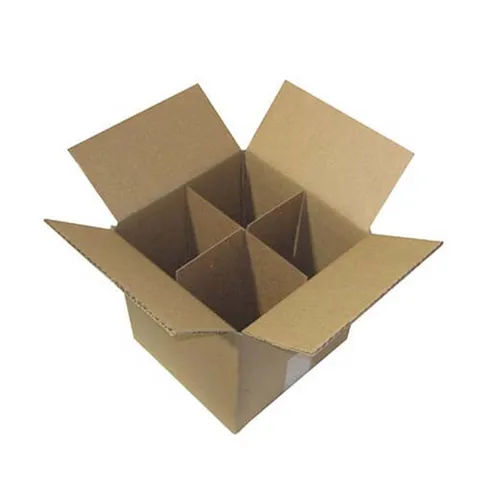 Kraft Box DividersSeparating items inside a boxMade to size · from £0.25Price this box
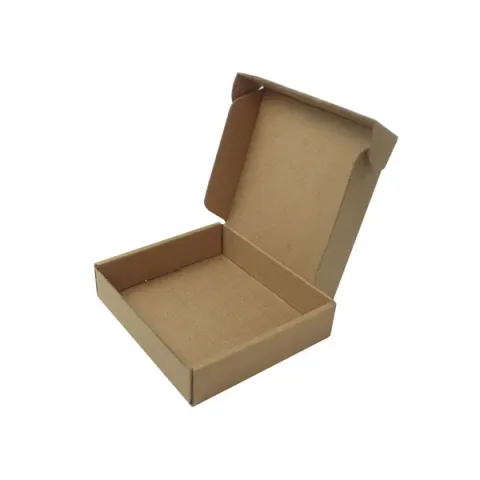 Kraft Shipping BoxesStock, bulk and heavier ordersMade to size · from £0.25Price this box
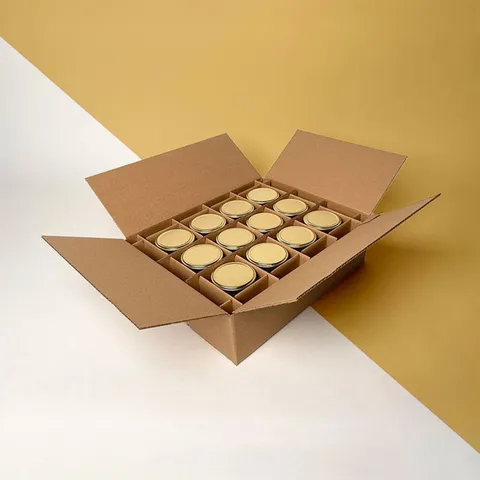 Kraft Bottle and Jar PacksGlass jars and bottles in transitMade to size · from £0.25Price this box
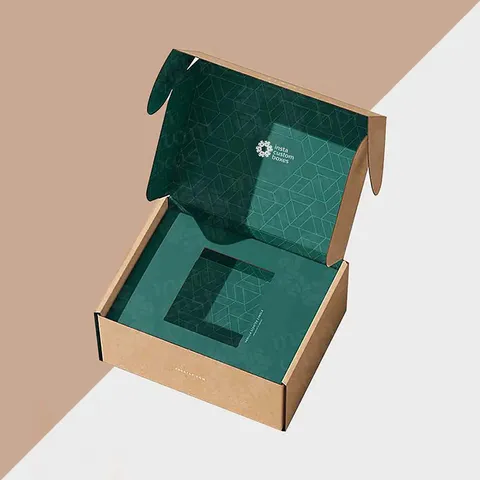 Kraft Mailer Boxes with InsertsKits, sets and fragile itemsMade to size · from £0.25Price this box
12questions answered
Questions About Kraft Bin Boxes
Straight answers from the people who cut and print the boxes. Open any question to read the reply.
Can you cut kraft bin boxes to my shelf depth?
Yes. Send the shelf depth and the clear height, and we size the bins so they fill the shelf without sticking out.
Do bin boxes need glue or tape to assemble?
No. They fold from one sheet and lock with tabs. Each bin takes less than a minute to put together.
Can a bin box have a sloping front?
Yes. A sloping front lets you see in from above and from the side, which suits shelving at eye level and below.
Can bin boxes be stacked on top of each other?
We can shape them to stack with the upper front set back. Stacking suits light stock such as packets and labels.
Can I have dividers inside a bin box?
Yes. Fixed walls can split one bin into two, three or more sections, so mixed small stock stays sorted.
Is there space on a bin for a label?
Yes. The front lip is a flat face for a sticker, a printed number or a handwritten label.
Can bin boxes be white instead of brown?
Brown kraft is standard. Ask for white-lined board if you want printed numbers to stand out.
Do bin boxes work on a shop floor?
Yes. A row of bins with a printed logo or number makes a tidy display for loose items such as socks or seed packets.
Can I order bins in several widths at once?
Yes. Mixing widths in one order is common, and we quote each width separately on the same written quote.
Will bin boxes fit standard shelving?
We cut them to the shelving you have. Measure your shelf rather than assuming a standard size.
Do you print a number on each bin?
We can print a run of numbers or letters on the front lips if you send the list with your artwork.
How are bin boxes delivered?
Flat, packed in cartons. They fold up when you need them, so spares store in very little room.
Tell us what you ship
Send the product, a rough size and a quantity. We reply in writing within one business day with a price and a free design proof. Prefer to talk? Call +44 7578 382054 or message us on WhatsApp.